FLUX 3: Every Confirmed Feature, Access Tier, and Benchmark Explained
Quick answer: can FLUX generate videos?
Yes. FLUX 3 Video handles text-to-video, image-to-video (with up to 10 keyframes), and video continuation. Clips run up to 20 seconds at HD, with Full HD available, and optional native synchronized audio that includes multilingual speech with solid lipsync, effects, and ambience. This guide separates what's actually live today from what's still coming, and lines up BFL's own benchmark numbers against the video tools creators already use Flux Ai Video Generator.
FLUX 3 at a Glance
| Specification | Details | |---------------------|-------------------------------------------------------------------------| | Announced | July 23, 2026 | | Built by | Black Forest Labs — founded by researchers behind latent diffusion and Stable Diffusion | | Core architecture | Self-Flow, trained jointly across images, video, and audio | | Max video length | Up to 20 seconds per clip; chainable into multi-minute sequences | | Video resolution | 720p during early access | | Native audio | Yes — generated in the same inference pass as video, not layered afterward | | Live now | FLUX 3 Video, FLUX 3 Action (both gated early access) | | Not yet launched | FLUX 3 Image, FLUX 3 Dev (open-weight) | | Public API | Not available for any tier yet |
What Makes FLUX 3 Different
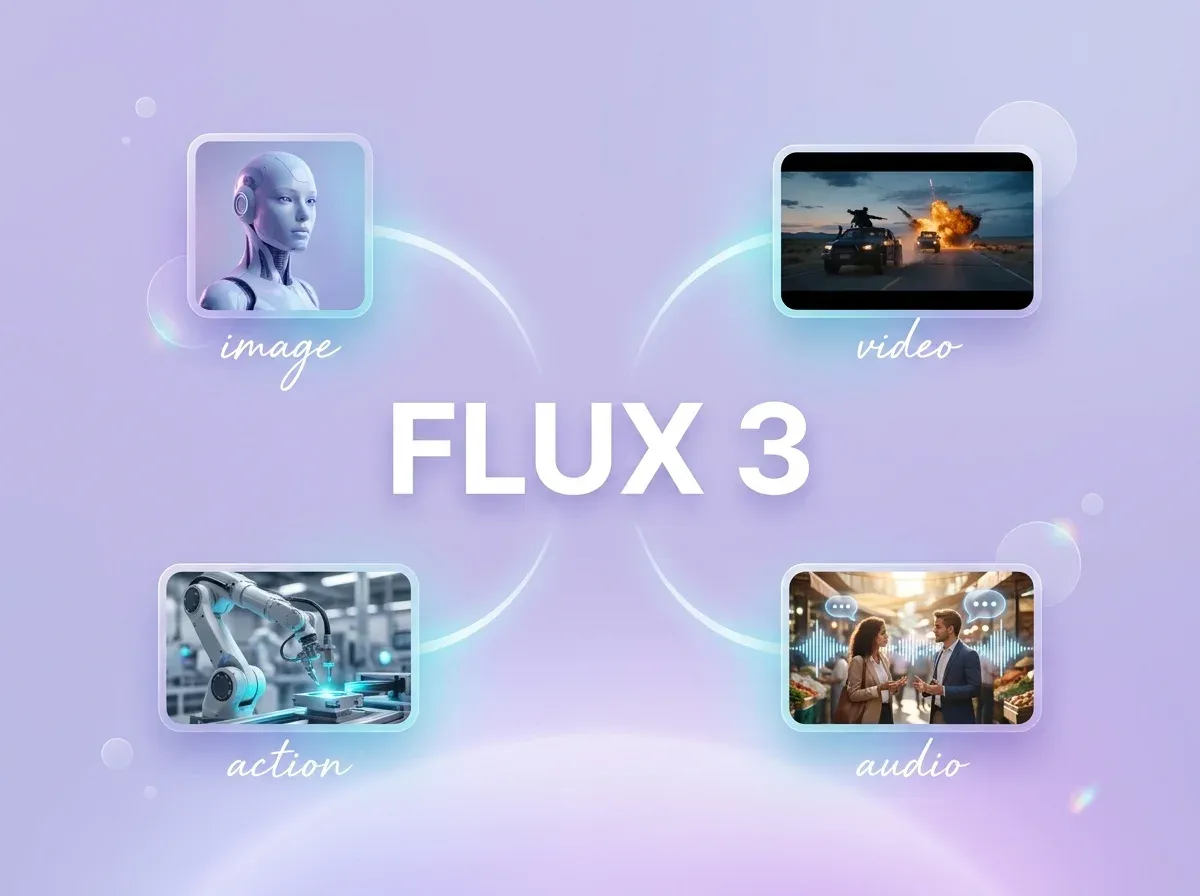
The core idea is that no single format ever tells the whole story. A photo freezes spatial structure at one instant. Video adds the missing dimension of time — how things actually move. Audio exposes something neither can: the causal link between a physical event and the sound it makes, which vision alone can't detect.
Train on all three together, and each one starts correcting the others. The sound has to match the impact. The motion has to respect the object's mass. The next frame has to logically follow the last one. BFL frames this as building a single working model of the world, rather than three separate, disconnected guesses at it.
That framing matters because it repositions FLUX 3 as more than "an image model that learned video." to Generate AI Image. It's meant to eventually cover content generation, world simulation, and physical action prediction from one shared backbone — and the team has a track record that makes the ambition credible. BFL's founders built the latent diffusion technique behind Stable Diffusion, and the company's earlier FLUX models already power generative features inside tools like Photoshop, Picsart, and Krea.
FLUX 3 Video: What's Actually Live
Video is the first piece open for testing, and currently the most broadly available part of the release.
Core capabilities
- Clips up to 20 seconds per generation, capped at 720p during early access
- Native synchronized audio generated in the same pass as the visuals, matched to on-screen physical events rather than dropped in afterward
- Agentic clip chaining, linking individual generations into multi-shot sequences lasting several minutes while keeping characters and style consistent across cuts
- A wide style range — candid camcorder footage, UGC-style clips, full cinematic output, and animation — without switching models
- Strong typography rendering, producing legible on-screen text and animated titles directly inside generated video
Six generation modes
| Mode | What it does | |-----------------------------|------------------------------------------------------------------------------| | Text-to-video | Full clip from a written prompt alone | | Image-to-video | Animates a still frame or uses an image as a style/composition reference | | Video-to-video | Carries characters, objects, or motion from a source clip into a new scene | | Keyframe-to-video | Smooth transitions between two or more defined keyframes | | Video + audio continuation | Extends a clip while continuing synchronized dialogue, music, and ambient sound | | Multilingual dialogue | Realistic speech across languages with synchronized lip-sync |
Real-world reaction has been fast and largely positive. Early testers on X have called out believable impact physics, character consistency across chained shots, and audio that actually lines up with visible motion — with several posts comparing FLUX 3 favorably against Seedance 2.0 in direct side-by-sides. The one recurring complaint from testers: image-reference inputs don't attach to output quite as reliably as pure text-to-video prompts do yet, which reads as an early-access rough edge rather than a structural flaw.
FLUX 3 Image: Coming, Not Here Yet
FLUX 3 Image remains in pre-launch evaluation. BFL has said it will open early access in the weeks following the video and action rollout, but nothing is publicly testable yet.
What BFL has shown so far, from its own mid-training evaluations:
- Meaningfully better handling of complex, multi-element prompts than earlier FLUX versions
- High-accuracy text rendering across multiple languages
- A wide output range spanning illustration, photography, product renders, and fine art
Treat these as a preview of direction, not a confirmed feature set — they come from BFL's internal testing, not independent hands-on review.
FLUX 3 Action: Video Understanding Meets Robotics
This is the part of the release most competitor coverage treats as a footnote, but it's arguably the most consequential piece. FLUX 3 Action extends the same world-understanding backbone into physical action prediction for robots.
BFL took two routes to get there: building native action prediction directly into FLUX 3, and using the pretrained video backbone as a dynamics-aware foundation that specialized robotics models can fine-tune from with limited task-specific data.
The first partner is mimic robotics. Together they built FLUX-mimic, a video-action model aimed at dexterous manipulation — and it's reportedly already being tested on an Audi production line for tasks like kitting parts and handling soft materials, with claims of sub-100ms reaction times on optimized hardware. That's a notably concrete proof point compared to most robotics announcements, which rarely name a real deployment this early. The underlying bet — that generating believable video and predicting physical action are the same problem viewed from two angles — is the boldest claim in the whole launch, and the one that will take the longest to independently verify.[ultrathink]
What's Live vs. What Isn't
| Product | Status | Access | |-----------------------------|---------------------|---------------------------------------------| | FLUX 3 Video | Live | Gated early access, application required | | FLUX 3 Action (FLUX-mimic) | Live | Limited to select robotics and research partners | | FLUX 3 Image | Not yet launched | Expected in the coming weeks | | FLUX 3 Dev (open-weight) | Not yet launched | Planned later in 2026 |
There's no public API for any FLUX 3 tier yet, and no pricing has been announced. Named early partners include Canva, Krea, Picsart, and Magnific — giving BFL several existing creative platforms to surface the model through before a standalone consumer product exists.
FLUX 3 vs. Other Video Models
BFL's internal preference evaluations used 10-second, 720p text-to-video clips with audio, tested against named competitors:
| Model | FLUX 3 preferred in | |------------------------|---------------------| | Luma Ray 3.2 | 93% | | Runway Gen-4.5 | 77% | | Grok Imagine Video | up to 69% | | Kling v3 Pro | 60% | | Happy Horse v1 / 1.1 | 59% / 57% | | Seedance 2.0 | 52% | | Gemini Omni Flash | 52% |
Two caveats matter more than the headline numbers. First, BFL labels this a preliminary evaluation of an early checkpoint, not necessarily the exact model now in early access. Second, the widest margins — against Luma Ray 3.2 and Runway Gen-4.5 — come against models that aren't currently setting the pace in independent rankings. The near coin-flip results against Seedance 2.0 and Gemini Omni Flash are the more telling data point, since those are the closest competitors on raw video quality, and it's the comparison BFL itself has committed to revisiting once the model reaches broader release.
FLUX 3 vs. FLUX 2: What Actually Changed
FLUX 2 was an image-only model built for realism and editing precision. FLUX 3 isn't an incremental step up from it — it's a structural departure.
Two things separate the two:
- FLUX 3 is the first FLUX model trained jointly across video and audio, not image alone
- It extends the same architecture toward physical action prediction, a category FLUX 2 never touched
On pure image quality, FLUX 3 claims better complex-prompt handling and text rendering than FLUX 2 — but that comparison stays unverified until FLUX 3 Image actually ships. Anyone deciding whether to wait treats video and action as the genuinely new territory, and the image claims as promising but not yet testable.
Who Gets the Most Out of FLUX 3
- Filmmakers and narrative creators — agentic clip chaining and keyframe control give shot-to-shot direction without manual compositing between generations
- Brand and campaign teams — accurate text rendering inside generated video and images matters for ads and packaging where legible on-screen copy is part of the concept
- Global content teams — native multilingual dialogue with synchronized lip-sync removes a step that used to require separate dubbing
Frequently Asked Questions
What is FLUX 3?
FLUX 3 is Black Forest Labs' first multimodal foundation model, trained jointly on images, video, and audio through the Self-Flow architecture. It generates video clips up to 20 seconds with native synchronized audio and extends toward physical action prediction for robotics, all from one model.
Is FLUX 3 available to the public?
Partially. FLUX 3 Video and FLUX 3 Action are in gated early access requiring an application. FLUX 3 Image is expected within weeks, and FLUX 3 Dev, the open-weight version, is planned for later in 2026. No tier has public API access or announced pricing yet.
How long can FLUX 3 videos be?
Up to 20 seconds per generation at 720p during early access, extendable into multi-minute sequences through clip chaining.
Does FLUX 3 generate audio automatically?
Yes. Native audio is generated in the same pass as the video by default, synced to on-screen events, including multilingual dialogue with lip-sync.
How does FLUX 3 compare to Kling, Seedance, and Veo?
In BFL's own early evaluations, FLUX 3 was preferred in roughly half of comparisons against Seedance 2.0 and Gemini Omni Flash — essentially a tie — and by wider margins against Luma Ray 3.2 and Runway Gen-4.5. BFL has flagged these results as preliminary.
What is FLUX 3 Action?
FLUX 3 Action extends the same world-understanding backbone into robot action prediction, developed with mimic robotics as FLUX-mimic, and is reportedly being tested on an Audi production line.